
This guy…

Yeah. This guy could be remembered as the President who changed Social Security forever with his latest addition to the tax code: Section 530A.
As much as I wanted to hate on this new policy, “Trump Accounts” are actually a really interesting planning tool.
We’ll get into the specifics in a second, but just so you know I’m not blowing smoke, this is what Ted Cruz said:
“Here’s the dirty little secret. Trump accounts are Social Security personal accounts”
A year earlier, Scott Bessent said something eerily similar. Calling them “a backdoor for privatizing Social Security.”
They’re essentially describing what policymakers have been trying to figure out for decades. How to give Americans an individual investment component alongside (or potentially replacing some portion of) traditional Social Security to preserve the program.
To be clear, there is no legislation currently on the table that says Social Security is being privatized. The Bush administration tried to go in this direction 20 years ago and it failed. That’s not what I’m saying.
But there is an interesting conversation going on right now about the ties between Trump Accounts and the safety net program, especially as the future state of the Trust Fund is in question.
So, to fill you in on what I’ve been looking into, I want to break down why many retirees fear for the future of their monthly benefits, who Trump accounts may be right for, and what the hell do accounts for newborns have to do with Social Security?
Let’s dive in.
What’s actually happening?
Many people are aware that the Social Security trust fund—the pool of money that is specifically earmarked for retirees and those with a disability—is in trouble. Big trouble. Trouble to the tune of being depleted by 2032. And it will continue to be unless Congress does something about it.
Polls show that most Americans don’t actually understand what would happen if the Social Security trust funds went to 0.
Many believe that the proverbial well will run dry and benefits would completely stop flowing. But that’s not exactly true.
What we have on our hands is a cash flow problem.
The latest Social Security Trustees Report projects that the retirement-only trust fund, OASI, will run out of reserves in the fourth quarter of 2032. And if we combine the retirement and disability trust funds, it only extends the X date by a couple of years.
This does not mean, though, that retirees who have already filed will wake one morning in 2032 and find their monthly checks are gone.
Social Security isn’t going away.
But… the proverbial well is running dry.
Under the current law, SS would continue to collect payroll taxes to pay benefits. The issue is that the money coming in isn’t enough to pay the full benefits that are going out.
The program’s costs have exceeded its non-interest income every year since 2010. Total spend began to eclipse total income in 2021 and the deficit is projected to remain going forward. To make up for the gap, we’ve been using the reserves to make up the difference.
The other problem is that we have more retirees filing for benefits than people paying into the system. In fact, the world’s 65+ population now outnumber children under 5 worldwide. I can’t even begin to cover the implications of this seismic shift.

Without getting in the weeds of birthrates and immigration policy, naturally, when you have fewer workers paying in for every retiree drawing out, the money coming in each year covers less and less of what’s going out.
And that’s important because according to an AARP poll last year, 81% of GenXers plan to rely on Social Security substantially or somewhat in retirement.
So if the reserves are gone, payroll taxes become the primary source of funding, and the Trustees project that the ongoing tax revenues would only be enough to pay ~78% of scheduled benefits.
In other words, recipients could see more than a 20% reduction in their benefits.
That’s the part everyone is freaking out about.
Now, there have been a few ideas that have floated around to fix the solvency issue—eliminate the payroll tax cap, expand the workforce by increasing the retirement age and incentivizing immigration, and others—but each option comes with a tradeoff, and so far, none of them seem to permanently solve the problem itself.
The other other problem is, politically speaking, Social Security is a nuclear football: no one wants to throw it to the other side, no one wants to catch it, and you’re fucked if you drop the ball.
The same guy above also empowered Elon Musk to try and convince us that the program itself is “the Ponzi scheme of all time” and cut over 12% of SSA staff to double down on that point. These were supposedly cost saving measures yet we’re still staring down the barrel of a pauperized system. So history is not exactly on his side yet.
What we do in the interim ultimately comes down to the path Congress chooses to go down.
So, until they do, where do we go from here?
This isn’t the first evolution of retirement planning
Before we get to the account itself, understand, we’ve already changed how we view retirement in America once.
Throughout most of the 1900s, retirement essentially stood on a three-legged stool: Social Security; a pension; and your own savings.
I’ve written about this shift before here. As pensions became less common, the responsibility for retirement savings has shifted from the employer to the employee.
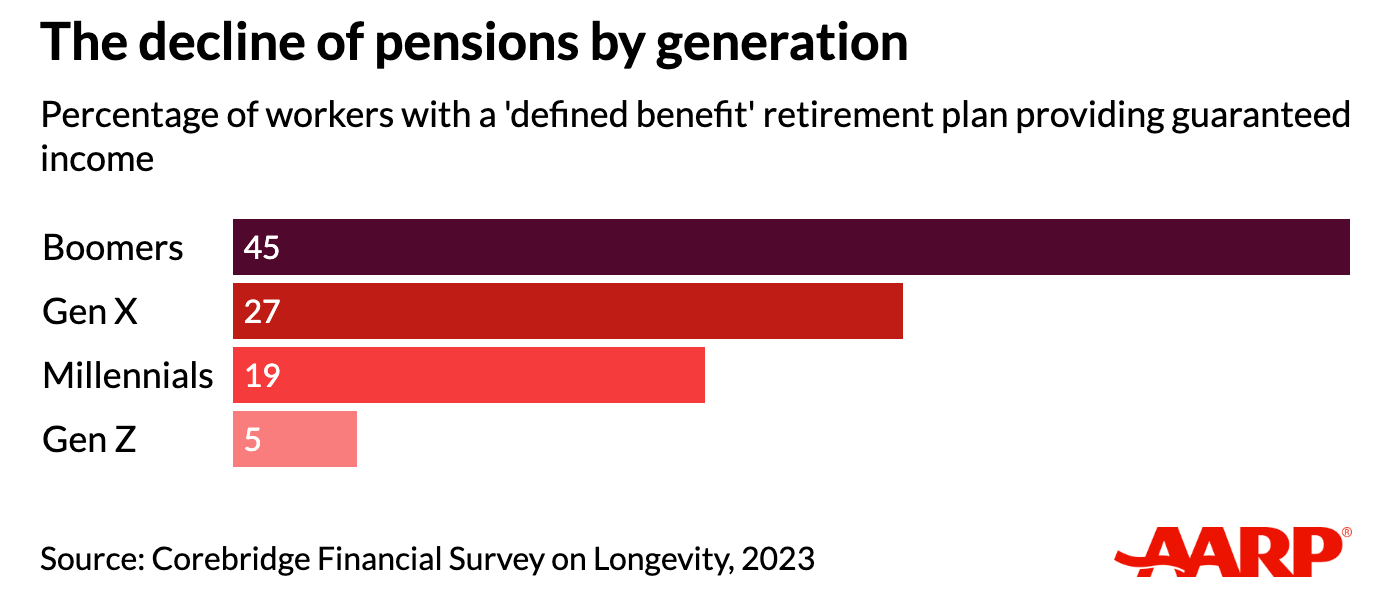
Now, this wasn’t all bad. The 401(k) and alike is and will be of the greatest wealth-building tools available to most of us. The internet tries to make it seem like we all need to be entrepreneurs and have a side hustle, but there’s nothing wrong with siphoning part of your income into an account that you can’t touch for years and quietly securing the bag.
Today, that three-legged stool is standing—it’s not even standing—on two legs, with one much more significant than the other.
Which instinctively means two things:
(1) The success of your desired lifestyle in retirement relies on your income and your ability to save; and
(2) When it comes to saving for it, the earlier the better
So I bring up workplace benefits for a few reasons. The disappearance of pensions is a great example of responsibility shifting from the institution to self-reliance. Second, workplace benefits–particularly an election you need to make every year—are one of the easiest ways for a new financial tool to become a normal part of our life. If your employer puts something in front of you and potentially contributes money to it, you’d be silly not to consider whether this is right for you or not.
We could be looking at the next evolution of these two playing out.
Around the time of July launch date, more than 50 companies already committed to offering Trump Account contributions for employees’ children. As adoption grows, maybe more follow. Who knows?
This means that companies could offer a Trump Account as an employee benefit, much like an FSA or HSA.
Cruz was again quoted saying: “Trump Accounts could eventually become a ubiquitous workplace benefit, much like 401(k) accounts, with employers matching employees’ contributions. Relatively speaking, it’s a pretty inexpensive employee benefit, but the potential benefit over time is massive.”
And that last part is the point I want to drive home.
Section 530A - “Trump Accounts”
For the right families, these accounts are a great way to kick-start the skills needed for long-term investing and retirement savings without the limitations, strings attached, or costs that 529s, UTMAs, Roth IRAs for minors, or establishing a Trust fund bring.
There’s still a lot to be learned, but the mechanics seem pretty simple so far.
They’re built on the chassis of a traditional IRA, with a few notable twists.
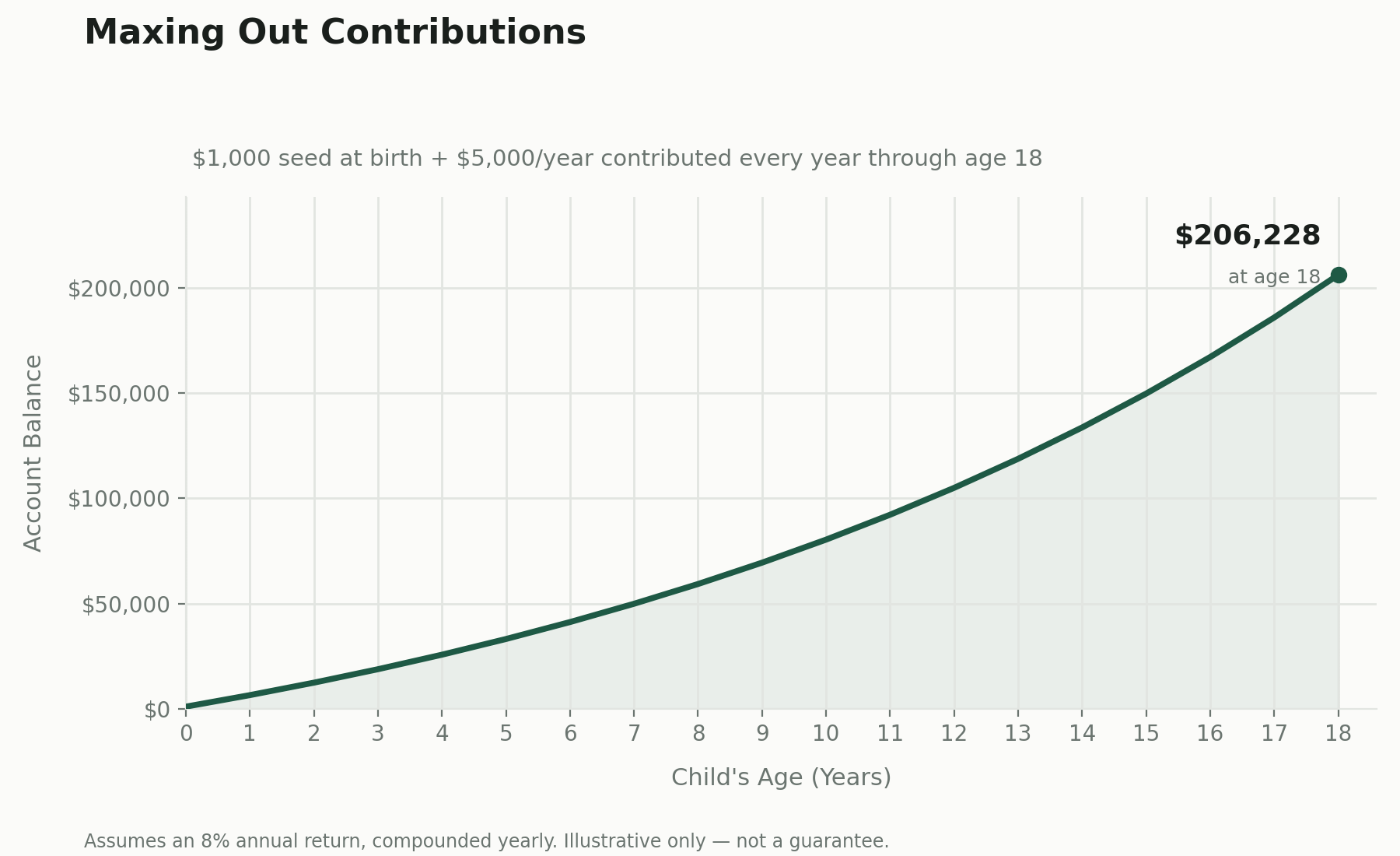
For starters, babies born between 2025 and 2028, the government provides a free one-time $1,000 as seed money, which doesn’t count toward the $5,000 contribution limit.
And not just parents, but grandparents, relatives, friends, employers, charities can contribute up to the $5,000 cap, and there’s no earned income requirements—the main hurdle that keeps families from funding a Roth IRA for their child from birth.
Employers can contribute up to $2,500 per year to an employee or their dependent’s account, which does count toward the annual limit. Which is fine because that means parents would only have to come out of pocket for the other half. That’s ~$100 every two weeks.
That may not sound like much, but this isn’t a saving account. We’re talking decades of growth.
The best part about it that this money is to be invested.
Which is extremely powerful. We’re potentially talking about a 60+ year timeline of uninterrupted compounded growth.
I’m not looking to pitch this thing as the next best thing since slide bread. But if we assume average market returns and consistent contributions, you’re child could have over $200,000 earmarked for first-time home purchase (up to $10k) or retirement by 18.
Here’s an interesting planning opportunity that prepared families may do.
At age 18, the account turns to an IRA. When your child is no longer a dependent, this would be a great opportunity to help them convert these funds to a Roth IRA. They’ll likely be working their first entry level roles, so income is low, and their earnings haven’t started to ramp up. Make sure you keep track of the basis; a (or series of) Roth conversion(s) growing tax free is going to be an amazing benefit with 40+ years until retirement.
Couples who don’t plan on having kids can save for nieces and nephews shortly after the little ones get a Social Security number. Low cost to you and if your employer offers the benefit, why not take it.
However, I say for the right families because, while a “free” $1,000 from the government is compelling, they are still not a no-brainer.
Affluent families with teenagers are usually already maximizing their annual gifts through other means. For them, the question is utility. If funding education is the highest priority, a 529 is going to be much more impactful.
And due to Medicaid’s strict asset limits, more planning will need to be considered for families with children with disabilities.
There are real limitations to keep in mind. My friend Marisa Rothstein wrote about many of the accounts’ shortcomings here.
Why they could be the new Social Security?
With all that said, I’ll admit, asking if Trump Accounts will become the new Social Security is probably the wrong question.
You’ve probably already put together that they certainly aren’t going to solve the current solvency issues today.
Kids born today who can actually benefit from these accounts won’t be able to touch it until the late 2080s.
By then, unless something changes, Social Security may very well still be paying out cents on the dollar in today’s terms. Republicans currently hold Congress and the White House, and that majority control still wasn’t enough to prevent one of the longest government shutdowns in U.S. history. So if we can’t agree on basic funding, it’s hard to feel confident about how we’ll tackle something as politically radioactive as Social Security.
Calling Trump accounts a replacement for the age-old safety net program, designed to protect the vulnerable and the sick, is a stretch without acknowledging the inherent differences.
Again, Social Security isn’t going away.
But it is hard to ignore the fact that as we get closer to the 2032 X date, the lopsided three legged stool that retirement once sat on, now down to two, is becoming increasingly reliant on one leg.
I believe these accounts are interesting because it has the ability to make up that difference and some.
With the lack of clarity on what the government will decide to do and the growing demographic divide, the more I look into Trump Accounts, the more I’ve changed my tune about the role they play. It doesn’t solve the whole problem, but they could be the missing link for the generation born today.
For new parents—especially if you question the long term integrity of Social Security—I would highly recommend looking into whether a Trump Account makes sense for your family.
Agree with this take! you might find this essay i wrote interesting, and in line with your thinking, too
https://www.grantvarner.com/p/how-does-america-escape-its-fiscal?r=3221f1&utm_campaign=post&utm_medium=web