
Well…. I did not see that coming.

In the time since I originally drafted this article and was ready to hit publish, two groundbreaking stories have completely changed where I was going with this.
However (and unfortunately), the news about Jensen Huang stepping down actually perfectly ties into the theme of today’s conversation.
The WSJ pointed out:
The company said Thursday that finance chief Colette Kress had agreed to serve as interim CEO until a permanent successor is named. The board is starting a search for the company’s next CEO and will consider internal and external candidates.
It’s wild to me that a trillion-dollar company that’s breaking records nearly every quarter, the focal point of every tech story, the darling child of the AI wave, and no one thought to design a succession plan?
Well, in honor of Estate Planning Awareness Week in October, I wanted to share two interesting stories (the news about Jensen isn’t one of them, but stay tuned for more).
But instead of beating you over the head with practical advice about how so-and-so should have done this or that, I want to talk about the reality of being this wealthy.
Jensen Huang or Andy Byron reminders that being on top of the world doesn’t necessarily mean you have your shit together. And sometimes, your personal business has a way of becoming everybody else’s business too.
So, if you’ve ever wondered whether more money actually makes your problems easier, just think about where you are at this very moment.
If you’re reading this, chances are all your basic needs are met. You have access to the internet, some form of income, and a roof over your head to call home.
But it could be better, right? You could always earn more. You could have the latest doodads and gadgets. If you don’t own a home, but you’d like to, vamoosh! Now you do. And it would certainly be nice not to have to worry about where inflation is headed. Enough money in the bank would certainly solve these problems, right?
Maybe.
But it can also bring temptation, jealousy, and insecurity issues to a scale most of us will never experience.
I want to talk about a few unintended consequences when it comes to massive amounts of wealth. But first, let me set the scene.
If you’ve watched the show Succession, you’ll remember this. In Season 1, Kendall Roy decides that his father, Logan Roy, is no longer the right person to run Waystar Royco.
His goal was to get enough board members on his side to vote Logan out.

Kendall spends the episode trying to secure the votes he needs to get the job done.
He couldn’t rely on his estranged uncle Ewan. They haven’t spoken in years, but he’s not going to stab his own brother in the back. Not like that. But he does have Frank, the COO, on his side. Of course his brother Roman and friend/private equity “parasite” Stewy. He even flew all the way to a cancer treatment facility on Long Island for a board member who physically couldn’t make the meeting, but was adamant she’d dial in, just so she could hear his side of the story.
To be fair, it’s not like Kendall was coming out of left field.
Yes, his dad built the billion dollar enterprise that gave way to the life that he and his siblings live. The lives that they could live, the lives their children could live, and their children’s children and so on. But he also had a massive stroke, struggled with his memory, would completely space out doing mundane tasks, and even peed on Kendall’s office floor. On top of all that, he’s in his 80s.
Should he really be the CEO of a publicly traded billion-dollar company Seriously, what would the rest of the shareholders think if they knew exactly what was going on?
Anyway, as the vote commences, Logan refuses to leave the room.
Naturally, with the weight of the power and influence he wields, the board members begin to waver. Roman doesn’t have the hutzpa to go either direction, so his dad decides for him. Kendall’s plan fails, Logan retains control, and the people who voted against him are fired. Effective immediately.
But let’s put a pin in that.
A few episodes before that reveal another interesting dynamic we have to talk about.
While Logan is recovering from said stroke, Marcia, his second wife, controls who gets access to him and prevents anyone other than the nurses–including his kids and their families—from visiting.
Shiv becomes suspicious, and the lack of access only thickens the plot, especially given that Marcia has now been added to the family trust and stands to inherit his board seat upon his passing.
With these details in mind, let’s head to the real world.
The first real-life story involves Gerald “Jerry” Ford, the Texas banker and philanthropist who built Hilltop Holdings, a publicly traded financial services company that owns businesses including HilltopSecurities, PlainsCapital Bank, and PrimeLending.
Texas locals may know his name from hovering above SMU’s football stadium where he donated $20M to help build it.

According to Forbes, his net worth is estimated to be $3.1 billion.
The interesting wrinkle is that Ford’s four adult children—from his first marriage—are suing him over control of his remaining business interests and arrangements he’s established for the future. According to The WSJ, Gerald still holds a roughly 27% stake in the company he built, worth ~$600 million.
Their first argument: Jerry can no longer manage certain affairs independently.
In the court filings, the children allege that a traumatic brain injury in 2017 and other health conditions have contributed to their father’s cognitive decline.
More importantly, they also argue that certain documents were established by their father to “provide for an orderly succession of control” if their father died or became incapacitated.
However, each party disagrees over whether the latter condition has been met.
In many of the estate plans that I’ve seen, declaring someone incapacitated usually requires signatures from two independent physicians—a fail-safe to remove doubt that this person is truly incapable of managing their affairs.
Jeremy, the eldest son, is already CEO of the firm and has since been named chairman of the holding company.
It makes you wonder: why do this to his father, then? Do they actually have an argument here?
Rest assured Jerry’s side is fighting back.
In a letter to Hilltop’s board, his attorneys argued that this was all just an attempt by Jeremy to accelerate the transfer of control over certain FLPs that were intended to pass according to Jerry’s broader estate plan.
In other words, he’s saying his son is just throwing an expensive tantrum to get what he wants.
His attorney also writes,
“Contrary to any assumption that Mr. Ford’s net worth remains in the billions, Mr. Ford has already given away all but a fraction of his wealth to Jeremy and his coplaintiffs/siblings… This attempted seizure would strip Mr. Ford of significant current income and could deprive Mr. Ford of everything he has built.”
Yeesh! This is juicy enough already!
Now, the dispute isn’t over, and I certainly don’t have a dog in this fight, but it does beg the question: if being CEO of a multi-billion dollar enterprise with a massive inheritance sometime in the future isn’t “enough”... then what is?
To make matters worse, there is also a complicated blended-family dynamic to deal with.

The children claim that their father’s second wife, Kelli Ford, is influencing his decisions and limiting their access to him.
It’s almost like this was scripted.
Keep in mind Texas is a community-property state. Generally speaking, this means all assets and income made after marriage are presumed to be communal assets. And when you’ve been married as long as they have, over 25 years, determining whether an asset belongs to one spouse or to the marital community would be a difficult proposition without proper documentation.
We don’t know the full details. Kelli has her own relationship with her husband (and her own children to think about), just as his children have their own history with their father.
The second story is about the family behind the famous whiskey brand, Jack Daniel’s.
The Brown family has controlled the business for more than 150 years. The family’s wealth has been passed down through six generations!
I can’t even begin to tell you how impressive that is.
They’ve been able to accomplish this through a family investment entity called Wolf Pen Branch, which holds a large block of the company’s voting shares. Essentially, it allows participating family members to coordinate how those shares are voted. And with ~60% of the voting power, as long as they continue to put up a united front, the family ultimately controls the company.
Great. Now here’s the problem.
No one drinks anymore. I mean, we do, but certainly not like we used to.
In fact, the percentage of Americans who say they drink alcohol is at a generational low. We are more health-conscious than ever—peptides, GLP-1s, protein chips, bath houses, Oura rings, etc.—which has not boded well for a family in the vice business. Demand for their flagship product is under pressure.

And the family business stock price has fallen by 60% over the last five years.
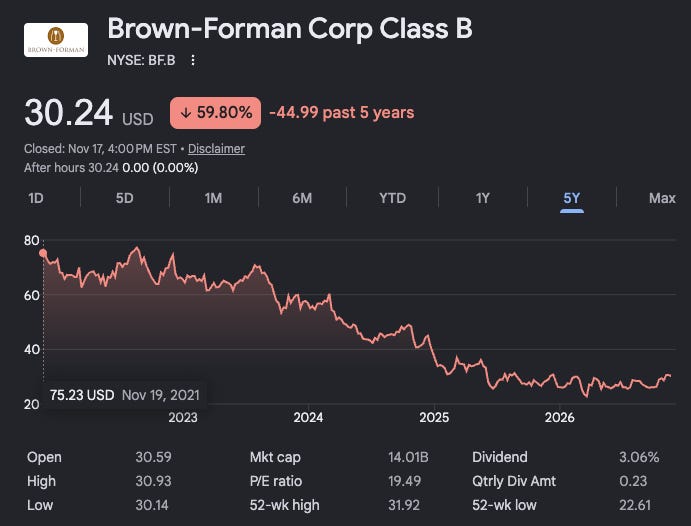
That’s enough to put any family whose wealth is tied to one particular stock over the edge.
Recently, the company was hit with a $15 billion hostile takeover bid which Brown-Forman’s board rejected. And they fended off a potential merger with another spirits company months earlier.
As the company navigates these challenges, disagreements within the family are coming to the surface.
Two heirs, neither part of Wolf Pen Branch, sent a lengthy letter to more than 130 relatives criticizing the board’s decisions and how they handled the merger discussions. The brothers accused the board and their own family members of keeping them in the dark and “rewarding failure.”
So, what happens when some family members want that sweet sweet liquidity event while others view cashing out as an affront against the family heritage?
Trust me, it’s tempting to assume a fortress built over 150 years should withstand almost anything. But no business is immune to changing markets, new trends, political and regulatory changes, or even its own internal disagreements.
Going back to Succession, this parallel is interesting because this is essentially the premise of the whole show.
Waystar Royco operates in the news, entertainment, and local television industry; all of which face significant disruption from big tech, social media, and changing consumer habits. The question is whether Logan’s old-school, pirate-mentality, relationship driven approach can adapt to the next generation of short-form media and rapidly changing technology, or whether the Roy children will be stuck holding the bag in a dying industry.
These are examples #11,801 and #11,802 that money doesn’t solve everything.
It’s a pretty good reminder that success, wealth, and power doesn’t necessarily translate into a “perfect” life.
Just look at Jensen Huang, who resigned as CEO last Thursday following the reports of two extramarital affairs, or Jeff Bezos in 2019.
No marriage is perfect, no. But imagine fights with your spouse—I’m talking about the big ones—on the front page of the New York Times.
Suddenly a little privacy becomes invaluable.

When you’re this wealthy, it’s almost impossible to avoid the public eye.
Your name, relationships, and even your personal affairs can become public information. Now, affairs weren’t supposed to be a pun, but hey, here we are.
I’ve helped clients effectuate strategies that helped create an additional layer of privacy when it came to making certain transactions or avoiding probate. Some families use code names for their revocable trusts and/or LLCs to keep their legal name off public-facing records.
Now, these structures don’t always guarantee anonymity in all facets of life, but they can provide a nice buffer in certain places.
Good relationships with your family are crucial
The bigger the dollars, the bigger the expectations, and when that much money is involved, not everyone is going to share the same idea of what’s fair.
And equal doesn’t always mean fair, either.
Disagreements over who’s going to own what, who gets to make decisions, and who should be in charge are hard enough as it is. When you add millions of dollars and trying to make these decisions in a high pressure situation could leave you rarely speaking to each other ever again.
And it’s even more difficult to sort things out once everyone is already in their respective corners fully set in their ways.
Your circle gets very small when you’re among the wealthiest people in the country
By the very nature of being in the 1%, fewer people can relate to your circumstances. And this is important: just because you’re rich doesn’t mean other rich people will automatically understand you or where you come from.
Some people have been wealthy their entire lives. They grew up in a world that most of us will never experience. Others build their wealth much later in life. The median age of the world’s billionaires is 67.
And some completely break the mold and go from poverty to unbelievable wealth. Trust me, no one has imposter syndrome and feels more like a fish out of water than this camp. Wealthy people still struggle with feelings of belonging and self-esteem, just like everyone else.
And to the end, it’s difficult to know who genuinely cares about you and your well-being.
I imagine it feels like most people you interact with either wants something from you, wants to sell you something, or are only there because you pay them.
Finding genuine friendships and a meaningful romantic relationship only becomes more complicated when you know money and status are part of the equation.
Because you cannot buy loyalty.
The right people stick around because they care. They care about you, your cause, and what you stand for. Otherwise they’ll move on to the next highest bidder.
Perhaps most importantly, you can’t get time or family back
These are priceless.
Regardless of how much money you do or don’t have, losing a loved one is one of the hardest experiences to go through.
No amount of wealth can buy back the time you didn’t spend with your siblings, fix the broken relationship with your dad, or guarantee that your kids will—or even want to—carry on the legacy the you envisioned.
I’ve written about this before here. Your legacy isn’t what gets passed down on paper. It’s what you decide to leave behind and how people remember what you did for them.